DHEA Benefits for Men 2026: Powerful Guide to Testosterone & Health
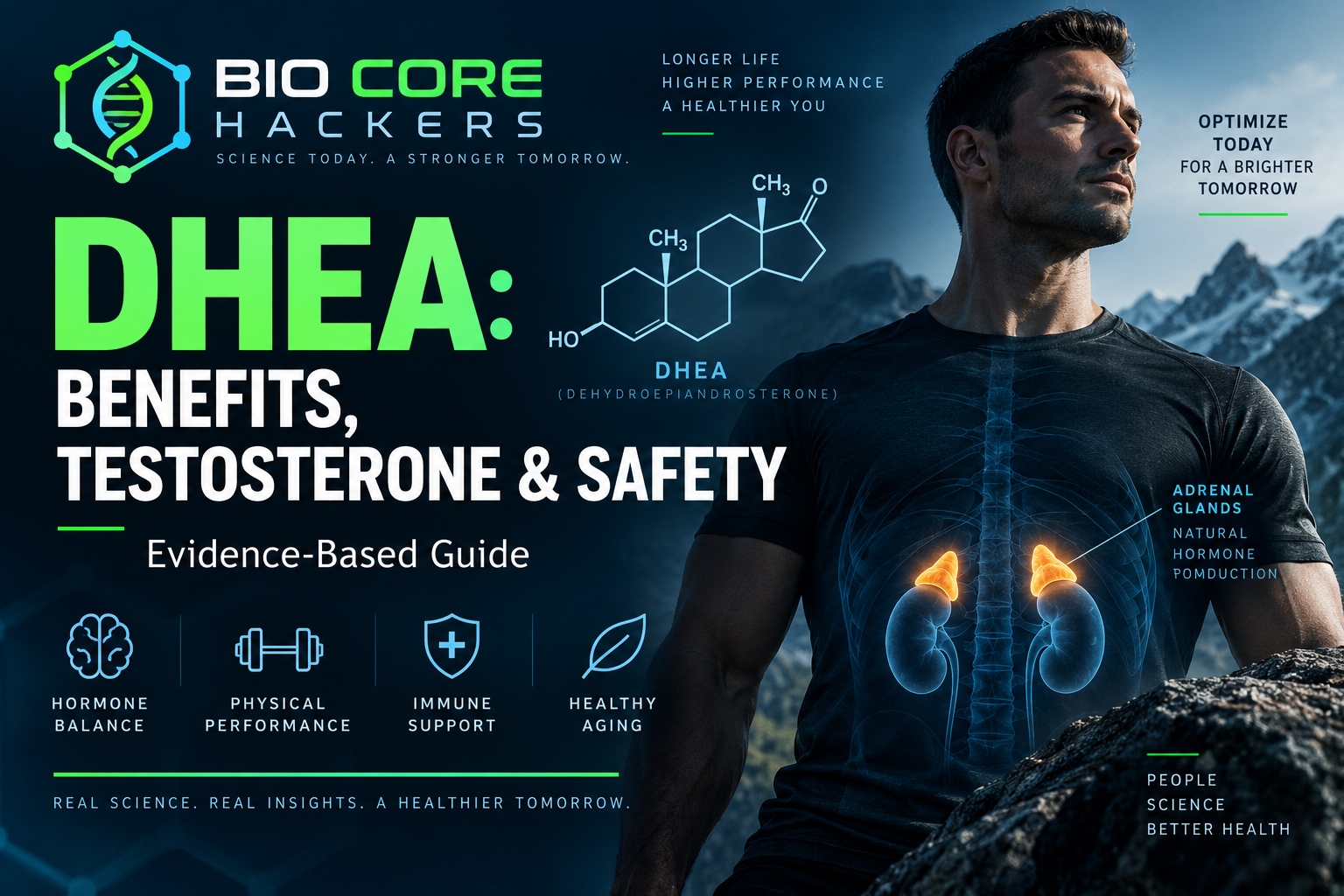
DHEA Benefits for Men 2026: 7 Powerful Facts You Should Know
DHEA benefits for men have become a major topic among men interested in testosterone, muscle growth, energy, sexual health, performance and healthy aging.
DHEA — short for dehydroepiandrosterone — isn’t an ordinary vitamin or gym supplement. It is a steroid hormone naturally produced primarily by the adrenal glands, and the body can use it as a precursor in pathways that produce hormones including testosterone and estrogen.
That makes DHEA scientifically interesting, especially for men concerned about declining hormone levels with age. But it also means DHEA deserves considerably more caution than supplements such as creatine or protein.
In this BioCore Hackers guide, we’ll examine DHEA benefits for men, its relationship with testosterone, muscle and body composition, what happens as DHEA declines with age, possible side effects and whether supplementation actually makes sense.
Medical disclaimer: This article is for educational purposes only and isn’t medical advice. DHEA is hormonally active. Talk with a qualified healthcare professional before using DHEA, particularly if you have a medical condition or take medication.
Table of Contents
What Is DHEA?
DHEA stands for dehydroepiandrosterone.
It is an endogenous steroid hormone produced largely by the adrenal glands. The body can convert DHEA through several biochemical pathways into other sex hormones.
According to Mayo Clinic’s DHEA overview, DHEA is a hormone naturally produced by the body and is involved in the production of other hormones, including testosterone and estrogen. However, evidence supporting many anti-aging and performance claims remains limited.
A simplified pathway looks like this:
Cholesterol → Pregnenolone → DHEA → Androstenedione → Testosterone / Estrogens
DHEA also circulates extensively as DHEA-S, or dehydroepiandrosterone sulfate.
According to Mayo Clinic, natural DHEA concentrations generally peak during early adulthood and gradually decrease with age.
This decline is one reason DHEA supplements have been promoted for testosterone, energy, physical performance and anti-aging purposes.
However, a hormone declining naturally with age doesn’t automatically mean restoring it through supplementation will make someone younger, stronger or healthier.
DHEA vs DHEA-S
DHEA and DHEA-S are closely related but aren’t exactly the same.
DHEA is a steroid-hormone precursor, while DHEA-S is its sulfated form and circulates in much higher concentrations.
The relationship can be simplified as:
DHEA ⇄ DHEA-S
Because DHEA-S is relatively stable, clinicians may measure DHEA-S in blood tests when evaluating adrenal androgen production.
This is important because someone shouldn’t assume that fatigue, reduced performance or lower libido automatically means they have low DHEA.
Testing provides far more useful information than guessing.
7 DHEA Benefits for Men and Important Facts
Let’s examine seven areas commonly associated with DHEA benefits for men and separate plausible mechanisms from exaggerated supplement marketing.
1. DHEA Benefits for Men and Testosterone
The relationship between DHEA and testosterone is probably the biggest reason men become interested in DHEA supplementation.
Because DHEA participates in androgen production, researchers have investigated whether supplementation can increase testosterone concentrations.
A systematic review and meta-analysis of randomized controlled trials found that DHEA supplementation increased testosterone levels on average, although the effect varied substantially between different groups.
A systematic review and meta-analysis published on PubMed examined randomized controlled trials of DHEA supplementation and found an overall increase in testosterone concentrations, although results varied according to factors such as sex, age and dose.
Across 42 publications, the reported weighted mean increase was approximately:
+28.02 ng/dL testosterone
However, the increase specifically reported for men was smaller than for women.
This is an important distinction.
An increase in testosterone on a blood test does not automatically mean a man will experience dramatic improvements in muscle, strength, libido or energy.
Individual responses may depend on:
- Age
- Baseline DHEA levels
- Baseline testosterone
- Dose
- Duration
- Health status
- Individual hormone metabolism
Therefore, one of the potential DHEA benefits for men is an influence on testosterone levels, but DHEA shouldn’t be marketed as a guaranteed testosterone transformation.
For lifestyle-based strategies, read our complete guide on how to boost testosterone naturally.
2. DHEA Benefits for Men Interested in Muscle Growth
Can DHEA help you build more muscle?
This is where marketing often moves much faster than the science.
Because DHEA can participate in androgen production, it sounds logical that supplementation could increase anabolic activity.
But a plausible biological mechanism isn’t the same thing as a proven bodybuilding effect.
Research investigating DHEA for muscle strength and physical performance has produced mixed results. Mayo Clinic notes that most studies haven’t shown an improvement in muscle strength in younger or older adults.
That means DHEA shouldn’t be treated like a proven muscle-building supplement.
For hypertrophy, the basic equation remains far more important:
Muscle Growth = Progressive Training + Protein + Energy + Recovery + Consistency
If you’re looking for a supplement with much stronger evidence for resistance-training performance, creatine is a much more established option.
Protein and muscle growth
Protein intake also matters considerably more than chasing hormonal shortcuts.
A commonly used evidence-based range for people engaged in resistance training is around:
1.6–2.2 g protein/kg/day
For an 80 kg man:
80 × 1.6 = 128 g protein/day
At the upper end:
80 × 2.2 = 176 g protein/day
That creates an approximate range of:
128–176 g protein/day
depending on goals, calorie intake, training volume and individual needs.
No supplement compensates for inadequate training and nutrition.
3. DHEA Benefits for Men and Energy
Energy and vitality are frequently included among claimed DHEA benefits for men.
This needs careful interpretation.
DHEA is involved in numerous physiological processes, but taking DHEA doesn’t work like consuming caffeine or a stimulant.
Low energy can have many causes, including:
- Poor sleep
- Excessive calorie restriction
- Stress
- Overtraining
- Nutritional deficiencies
- Medication
- Thyroid disorders
- Low testosterone
- Other health conditions
Someone experiencing persistent fatigue should therefore investigate the cause instead of assuming DHEA is the solution.
If you’re looking for training energy rather than treating a hormonal issue, nutrition, hydration, sleep and an appropriate pre-workout strategy are more logical places to start.
You can also read our natural pre-workout drink guide for a non-hormonal approach to preparing for training.
4. DHEA Benefits for Men and Healthy Aging
Healthy aging is another major area in which DHEA benefits for men are heavily advertised.
The marketing argument usually looks something like this:
Age ↑ → DHEA ↓
Therefore:
DHEA supplementation → Reverse aging
The first observation is real. The conclusion isn’t established.
DHEA concentrations generally decline as people age, but replacing DHEA hasn’t been proven to reverse biological aging.
Mayo Clinic reports that evidence doesn’t currently prove that DHEA supplementation counteracts the effects of aging.
That doesn’t mean DHEA is biologically irrelevant. It means we shouldn’t confuse an interesting hormone with a proven anti-aging therapy.
For healthy aging, focus first on factors with much stronger evidence:
- Resistance training
- Cardiovascular exercise
- Healthy body composition
- Adequate protein
- Quality sleep
- Blood-pressure control
- Good metabolic health
- Avoiding smoking
- Managing alcohol intake
- Regular medical screening
These aren’t as exciting as a hormone capsule, but they matter enormously.
5. DHEA Benefits for Men and Body Composition
Body composition is another reason DHEA attracts attention.
If DHEA can influence androgen levels, could it simultaneously help preserve muscle and reduce fat?
Possibly in some contexts, but DHEA isn’t a replacement for calorie management.
For fat loss, energy balance remains fundamental:
Energy Balance = Calories Consumed − Calories Expended
Imagine a man maintains his body weight at approximately:
2,700 kcal/day
He begins consuming:
2,200 kcal/day
His theoretical daily deficit becomes:
2,700 − 2,200 = 500 kcal
Across seven days:
500 × 7 = 3,500 kcal
Real-world weight loss isn’t perfectly linear because water balance, metabolic adaptation, activity and calorie intake fluctuate.
But the fundamental principle remains:
Sustained calorie deficit → weight loss over time
DHEA doesn’t override energy balance.
If your goal is reducing fat while preserving muscle, read our complete guide on how to lose weight without losing muscle.
6. DHEA Benefits for Men and Sexual Health
Sexual health is frequently mentioned when discussing DHEA benefits for men because DHEA is involved in sex-hormone metabolism.
But libido and erectile function are complicated.
Sexual function can be influenced by:
- Testosterone
- Cardiovascular health
- Sleep
- Psychological health
- Stress
- Medication
- Alcohol
- Body composition
- Metabolic health
- Relationship factors
DHEA shouldn’t therefore be viewed as a universal libido or erectile-dysfunction treatment.
Persistent erectile dysfunction deserves medical attention because it can sometimes be associated with cardiovascular or metabolic problems.
Similarly, men who believe they have low testosterone should consider proper testing rather than assuming DHEA will solve their symptoms.
Lifestyle factors also matter. Our guide to gut health and testosterone explains how broader metabolic and nutritional health can interact with hormonal health.
7. DHEA Benefits for Men Over 40
Interest in DHEA benefits for men over 40 is understandable because natural DHEA production generally declines with age.
But age alone isn’t a reason to start supplementation.
A 45-year-old man with excellent health, normal laboratory values, good sleep, healthy body composition and strong physical performance may have no reason to manipulate DHEA.
Conversely, someone experiencing persistent symptoms deserves proper evaluation.
A more intelligent approach is:
Symptoms → Medical Evaluation → Blood Testing → Interpretation → Appropriate Intervention
rather than:
Age 40+ → Buy DHEA
Healthy aging should focus on correcting actual problems rather than trying to restore every biomarker to levels seen at age 20.
How Much Can DHEA Increase Testosterone?
This is one of the most interesting questions surrounding DHEA benefits for men.
A 2020 systematic review and meta-analysis of randomized controlled trials found an overall testosterone increase of approximately:
28.02 ng/dL
following DHEA supplementation.
Importantly, subgroup analysis reported an average increase of approximately:
21.36 ng/dL in men
compared with approximately:
30.98 ng/dL in women
So let’s put the male result into perspective.
Imagine a man has total testosterone of:
500 ng/dL
If his testosterone theoretically increased by 21.36 ng/dL:
500 + 21.36 = 521.36 ng/dL
Percentage increase:
21.36 ÷ 500 × 100 = 4.27%
This is only an illustration — not a prediction of what will happen to an individual.
The meta-analysis pooled multiple studies and populations, and individual responses can differ significantly.
This is why claims such as “DHEA massively boosts testosterone” should be treated skeptically.
Is DHEA a Natural Testosterone Booster?
This depends on what someone means by “natural.”
DHEA occurs naturally in the human body.
But taking manufactured DHEA capsules is still exogenous hormone supplementation.
It is therefore different from improving testosterone-supportive lifestyle factors such as:
- Sleeping properly
- Resistance training
- Maintaining healthy body fat
- Consuming sufficient calories
- Correcting vitamin or mineral deficiencies
If you’re primarily interested in natural testosterone support, our Tongkat Ali benefits guide examines another popular supplement frequently discussed in this space.
DHEA vs Testosterone
DHEA and testosterone aren’t the same hormone.
DHEA: a steroid-hormone precurs

Post Comment